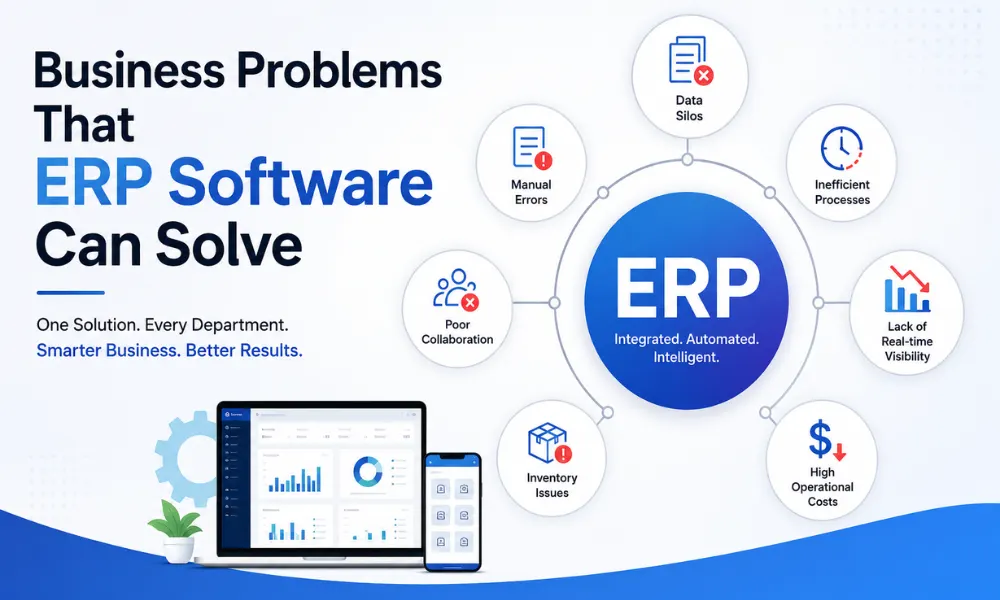
As businesses grow, so do their challenges. What once worked with spreadsheets and disconnected tools quickly becomes a bottleneck. Departments operate in silos, data gets duplicated, and decision-making slows down because no one has a clear, real-time picture of the business.
This is where Enterprise Resource Planning (ERP) software comes in. ERP systems bring every core function—finance, inventory, sales, HR, and operations—into a single, unified platform. The result is better visibility, fewer errors, and a business that can scale without breaking down.
Below are the most common business problems ERP software solves, and why more companies are turning to it as a long-term solution.
Common Business Problems ERP Software Solves
1. Scattered and Disconnected Data
Many businesses still rely on multiple standalone tools: one for accounting, another for inventory, another for HR. This creates data silos where information doesn't talk to each other, leading to inconsistencies and duplicate work.
How ERP helps: A centralized database ensures every department works from the same accurate, up-to-date information, eliminating data silos entirely.
2. Lack of Real-Time Visibility
Without a unified system, business owners and managers often make decisions based on outdated reports. By the time data is compiled manually, it may no longer reflect reality.
How ERP helps: ERP software provides real-time dashboards and reporting, giving leadership instant visibility into sales, stock levels, cash flow, and performance metrics.
3. Inefficient Inventory and Supply Chain Management
Manual inventory tracking often leads to stockouts, overstocking, and inaccurate demand forecasting, all of which directly impact profitability.
How ERP helps: ERP systems automate inventory tracking, sync stock levels across locations and channels, and use historical data to improve demand forecasting accuracy.
4. Manual and Repetitive Processes
Tasks like data entry, invoicing, payroll processing, and order management consume valuable time when done manually, increasing the risk of human error.
How ERP helps: ERP automates repetitive workflows, reducing manual effort and freeing up staff to focus on higher-value tasks.
5. Poor Financial Control and Reporting
Disconnected accounting systems often result in delayed financial reporting, inaccurate budgeting, and difficulty tracking expenses across departments.
How ERP helps: With integrated financial modules, ERP software provides accurate, real-time financial reporting and simplifies compliance, budgeting, and forecasting.
6. Limited Scalability
A business that relies on disconnected tools or outdated systems often struggles to scale efficiently. Adding new locations, products, or teams becomes a logistical challenge.
How ERP helps: ERP platforms are built to scale with your business, supporting multiple locations, currencies, and growing transaction volumes without major disruptions.
7. Poor Communication Between Departments
When sales, finance, inventory, and customer service operate independently, miscommunication is inevitable. This often results in delayed responses, order errors, and a poor customer experience.
How ERP helps: By centralizing information, ERP software improves cross-department collaboration, ensuring every team has access to the same accurate data.
8. Compliance and Regulatory Risks
Keeping up with tax regulations, industry compliance standards, and audit requirements is difficult when records are scattered across multiple systems.
How ERP helps: ERP software helps maintain accurate records, automate compliance-related processes, and generate audit-ready reports with minimal manual effort.
9. Inaccurate Demand Forecasting
Without consolidated sales and inventory data, predicting customer demand becomes guesswork, leading to either excess inventory or missed sales opportunities.
How ERP helps: ERP systems use historical and real-time data to improve forecasting accuracy, helping businesses plan production, purchasing, and staffing more effectively.
10. High Operational Costs
Disconnected systems, manual processes, and inefficient workflows often lead to higher labor costs, wasted resources, and lost revenue opportunities.
How ERP helps: By streamlining operations and automating processes, ERP software reduces overhead costs and improves overall operational efficiency.
Why Businesses Are Investing in ERP Software
The challenges above aren't isolated incidents, they're symptoms of outdated systems that can't keep pace with business growth. ERP software addresses these issues at the root by:
- Centralizing data across departments
- Automating repetitive and manual tasks
- Providing real-time insights for faster decision-making
- Supporting scalability as the business grows
- Reducing costly errors and inefficiencies
Businesses that implement the right ERP solution often see measurable improvements in productivity, accuracy, and profitability within months of adoption.
Final Thoughts
If your business is struggling with disconnected systems, inaccurate data, or inefficient processes, it may be time to consider an ERP solution. The right software doesn't just fix existing problems, it lays the foundation for sustainable, long-term growth.
Ready to streamline your business operations? Eqsoft’s Equal Plus offers powerful ERP solutions designed to centralize your data, automate manual processes, and give you real-time visibility across every part of your business, so you can solve today's problems and scale with confidence.
Ready to upgrade your business?
Join 10,000+ businesses running on EqSoft ERP. Get a free demo tailored to your industry.
Book Your Free Demo Today