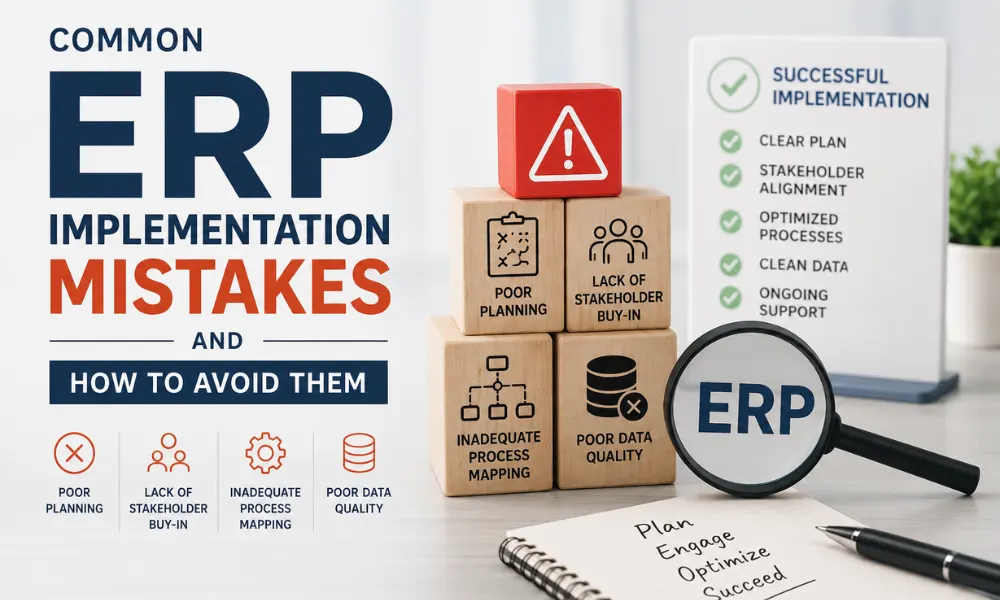
ERP implementation is one of the most significant technology investments a business can make, yet studies show that over 50% of ERP projects run over budget, over schedule, or fail to deliver expected value. The good news? Most of these failures are entirely avoidable.
Enterprise Resource Planning (ERP) systems have become the backbone of modern businesses. From streamlining supply chains and managing financials to automating HR processes and improving customer service, a well-implemented ERP system like Equal Plus can transform the way your organization operates. However, the first challenge is often choosing the best ERP software for your specific needs.
However, the path to a successful ERP deployment is filled with potential pitfalls that can derail even the most well-intentioned projects. Whether you are a small business implementing ERP for the first time or a large enterprise upgrading to a new platform, understanding the most common ERP implementation mistakes and knowing how to avoid them can save you time, money, and enormous frustration.
Why ERP Implementations Fail
Before diving into specific mistakes, it is important to understand that ERP failure rarely comes from the software itself. Most failures originate from poor planning, misaligned expectations, inadequate training, or organizational resistance. According to industry research, the average ERP project runs 30-50% over its original budget. Recognizing where things go wrong is the first step toward getting them right, starting with choosing the right ERP solution for your business. Let us explore the most critical ERP implementation mistakes businesses make, and the proven strategies to avoid each one.
The 7 Most Common ERP Implementation Mistakes
1. Skipping the Needs Assessment Phase
Many organizations rush into ERP selection without thoroughly analyzing their existing workflows, pain points, and future goals. Without a proper needs assessment, you risk choosing a system that does not align with your actual business requirements resulting in costly customizations or, worse, a complete system replacement.
HOW TO AVOID IT: Conduct a thorough business process review before evaluating any ERP vendor. Document current workflows, identify inefficiencies, and define clear objectives for what the new system must achieve. Involve department heads from finance, operations, HR, and IT in this process.
2. Underestimating Total Cost of Ownership
The sticker price of an ERP system is just the beginning. Many businesses fail to account for implementation services, data migration, staff training, customization, ongoing maintenance, and licensing renewals. This leads to significant budget overruns and stalled projects midway through deployment.
HOW TO AVOID IT: Build a comprehensive Total Cost of Ownership (TCO) model that includes hardware, software licenses, implementation partner fees, training costs, downtime risks, and at least three years of post-go-live support. Always add a 20% contingency buffer to your initial estimate.
3. Lack of Executive Sponsorship and Leadership Buy-in
ERP implementation is not an IT project, it is a business transformation initiative. When senior leadership treats it as purely a technical upgrade and delegates all responsibility to the IT department, the project loses strategic direction. Employees across departments may resist change, and critical decisions get delayed.
HOW TO AVOID IT: Appoint a C-suite executive as the project champion from day one. This person should communicate the vision, secure resources, resolve cross-departmental conflicts, and ensure the project stays aligned with broader business strategy. Visible leadership commitment dramatically increases adoption rates.
4. Poor Data Migration Planning
Data is the lifeblood of any ERP system. Yet data migration is consistently one of the most underestimated phases of ERP implementation. Moving legacy data into a new system without proper cleansing, mapping, and validation leads to corrupt records, duplicated entries, and broken workflows from day one.
HOW TO AVOID IT: Start data cleanup early—ideally months before go-live. Assign data owners in each department who are responsible for validating the accuracy and completeness of their data. Run multiple migration pilots and establish clear rollback procedures in case errors are discovered after launch.
5. Excessive Customization
Customizing an ERP system to match every existing process might seem logical, but it creates serious long-term problems. Heavy customization increases implementation time and cost, makes future upgrades extremely difficult, and often results in a system that is fragile and hard to maintain. Many organizations end up trapped on outdated software versions because their customizations are incompatible with newer releases.
HOW TO AVOID IT: Follow the 'configure, don't customize' principle wherever possible. Challenge every customization request by asking whether the business process should be adapted to best-practice ERP workflows instead. Reserve customization only for genuine competitive differentiators that cannot be achieved through standard configuration.
6. Inadequate End-User Training
Even the most powerful ERP system will fail if employees do not know how to use it effectively. A common mistake is treating training as a one-time event—typically a few days of instruction just before go-live. This leaves users overwhelmed and reverting to old manual processes or workarounds, undermining the entire investment.
HOW TO AVOID IT: Develop a role-based training program that is delivered in multiple phases—before, during, and after go-live. Create easy-to-access user guides, video tutorials, and in-system help resources. Designate 'super users' in each department who receive advanced training and serve as internal support resources.
7. No Change Management Strategy
Technology change is really people change. When organizations deploy a new ERP system without addressing the human side of the transformation—communicating why the change is happening, what it means for individual roles, and how employees will be supported—they face resistance, low morale, and poor adoption.
HOW TO AVOID IT: Develop a formal change management plan alongside your technical implementation plan. Communicate early and often about the benefits of the new system. Involve end users in testing and feedback sessions to create a sense of ownership. Celebrate milestones to build momentum and positivity around the transition.
Key Metrics to Measure ERP Implementation Success
Avoiding mistakes is only half the battle. To know whether your ERP implementation is truly succeeding, you need to track the right metrics. These include user adoption rates, system uptime and performance, process cycle time improvements, reduction in manual data entry errors, cost savings achieved versus pre-implementation benchmarks, and return on investment over a 12-36 month horizon.
"A successful ERP implementation is not just about going live, it is about continuously optimizing the system to deliver measurable business value over time."
Establish a post-implementation review process at 30, 90, and 180 days after go-live. Use these checkpoints to address user feedback, fine-tune configurations, and identify additional modules or integrations that could further improve efficiency.
Choosing the Right ERP Implementation Partner
Perhaps the most important decision you will make is choosing who will help you implement your ERP system. The right implementation partner brings not only technical expertise but also deep industry knowledge, a structured methodology, transparent communication, and a genuine commitment to your long-term success. Look for a partner with a proven track record in your industry, strong client references, and a clear post-go-live support model.
Avoid partners who promise unrealistically short timelines or suspiciously low costs; these are often warning signs of an under-resourced or inexperienced team.
Final Thoughts
ERP implementation is a complex journey, but with the right preparation, leadership, and partner, it is one that delivers extraordinary rewards. By proactively addressing the common mistakes outlined in this guide, from thorough needs assessment and realistic budgeting to robust training and change management, your organization can dramatically improve its chances of a smooth, on-time, and on-budget go-live.
The businesses that succeed with ERP are those that treat it not as a one-time project, but as a continuous investment in their operational foundation. That is where Equal Plus and EqSoft come in. With deep ERP expertise, a proven implementation methodology, and an unwavering focus on client success, EqSoft helps businesses of all sizes navigate the complexities of ERP deployment—avoiding the costly mistakes that derail so many projects. Whether you are just beginning your ERP journey or looking to optimize an existing system, EqSoft is the partner you can trust to get it right.
Ready to upgrade your business?
Join 10,000+ businesses running on EqSoft ERP. Get a free demo tailored to your industry.
Book Your Free Demo Today