Ask any manufacturing unit owner what keeps them up at night, and you'll rarely hear "I wish I had fancier software."
You'll hear this instead:
Where did all that raw material go?
Why did this batch cost so much more than the last one?
It's the 18th, and we still haven't closed last month's GST.
These aren't small annoyances. They eat into profit every month, and most manufacturers don't realise how much until they calculate the actual loss.
This is exactly where ERP software used in manufacturing industry setups earns its place—not as a buzzword, but as a practical fix for problems already costing you money.
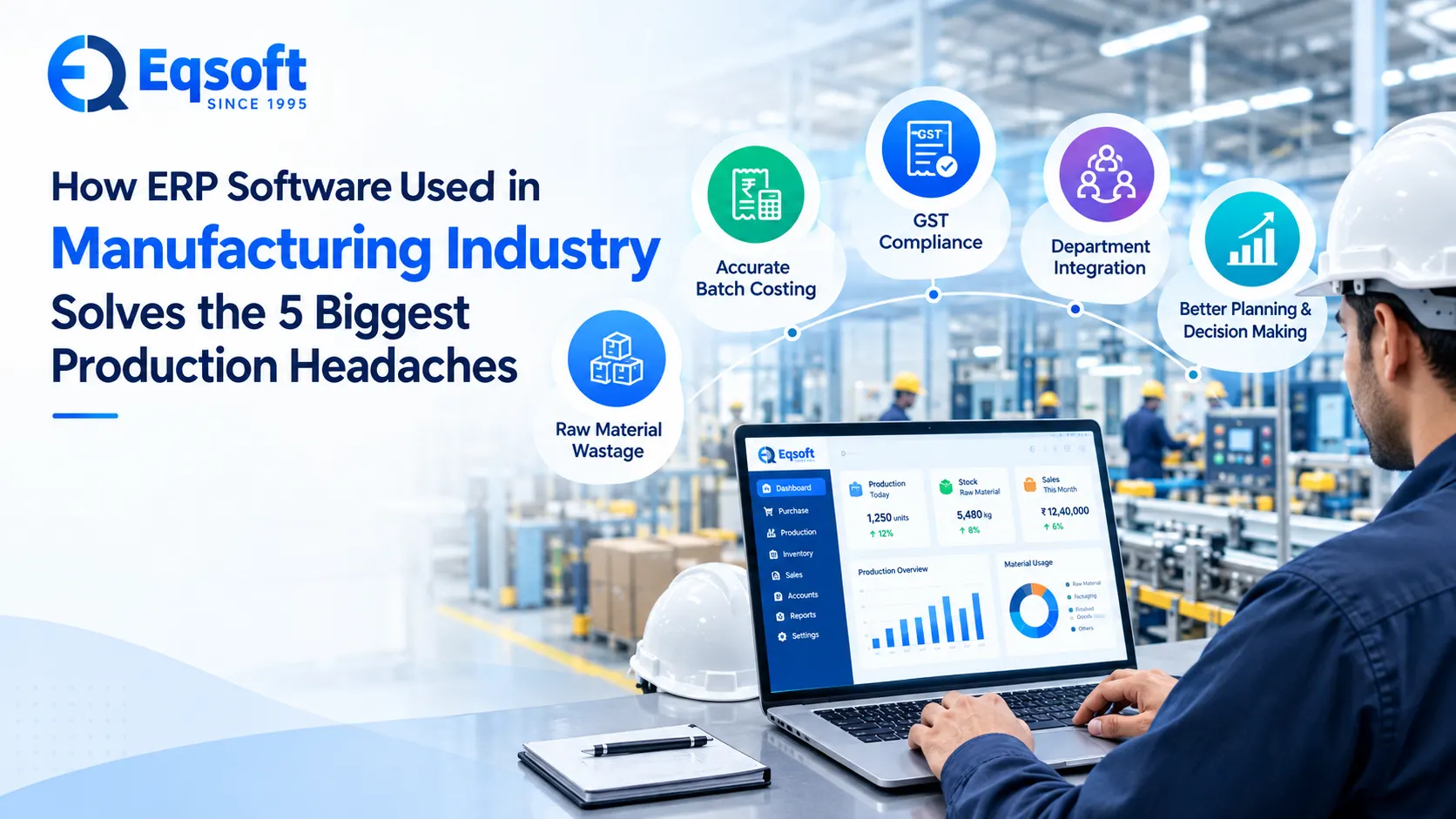
We've spent over three decades working with manufacturing, retail, and wholesale businesses across Kerala, and the same five problems come up again and again. Here's how the right ERP system actually solves each one.
Raw Material Wastage Nobody Notices Until It's Too Late
In most manufacturing units, raw material tracking still happens on paper registers or scattered Excel sheets. Store staff write down what came in and what went out, but nobody has a real-time picture of what's happening on the floor.
By the time someone does a physical stock count, the numbers don't match. Some material was wasted in production, some was double-entered, and some simply went missing.
ERP software built for manufacturing tracks raw material from the moment it enters the store to the moment it becomes a finished product. Every issue, return, and wastage gets logged automatically. If something looks off, you catch it the same week, not three months later during an audit.
You Don't Know the Real Cost of a Batch Until It's Already Sold
Most manufacturers know their raw material cost and their selling price, but the actual cost of production—labour, machine time, wastage, overheads—is usually a rough estimate at best.
That means some products might get sold at a loss without anyone realising it, simply because the true production cost was never calculated properly.
ERP software used in manufacturing industry setups solves this with automatic batch-wise costing. It pulls together material, labour, and overhead costs for each production run, so you know the real cost per unit before deciding on pricing, not after.
GST and Compliance Season Turns Into a Fire Drill
Every month, someone in accounts scrambles to match purchase invoices, sales records, and stock movement before the GST deadline. With multiple product lines or several suppliers, this gets messy fast. Manual reconciliation means errors, missed input tax credit, and last-minute stress.
A proper ERP system keeps purchase, sales, and stock data connected from day one. GST reports get generated directly from real transactions, not re-typed into a separate file. Filing becomes a five-minute task instead of a five-day scramble.
Purchase, Production, and Accounts Are Not Talking to Each Other
In many units, purchase, production, and accounts work like three separate islands. Purchase orders raw material without knowing current stock. Production starts a batch without confirming material has arrived. Accounts finds out about a purchase only after the invoice lands on their desk.
This disconnect causes delays, duplicate orders, and constant back-and-forth just to get basic information.
ERP software brings all three departments onto one shared system. When production requests material, purchase sees it instantly. When a purchase is made, accounts sees it in real time. Nobody has to chase anyone for information that should already be available.
You're Always Reacting, Never Planning
Without real-time reports, most decisions happen only after something has gone wrong. Stock runs out, so now there's a rush order. A machine sits idle for two days, and nobody notices until the monthly review. That's a business running on firefighting instead of planning.
With ERP software, owners and managers get live dashboards showing stock levels, production status, and sales performance at any moment. Instead of waiting for a monthly report to learn something went wrong, you see it happening and act right away.
So, Is ERP Software Really Worth It for a Manufacturing Unit?
Here's the honest answer: ERP software isn't magic, and it won't fix a business overnight. It needs proper setup, some training, and patience during the first few weeks as everyone adjusts.
But once it's in place, the difference is real. Less wastage, accurate costing, faster GST filing, and departments that actually work together—these usually add up to far more savings over a year than the cost of the software itself.
This is why ERP software for manufacturing has moved from a "nice to have" to something most serious manufacturing units in Kerala are now adopting. It's not about keeping up with trends; it's about running the business with fewer surprises and better numbers.
Built for Kerala Manufacturing Units
At EqSoft, our Equal ERP system was built with exactly these problems in mind. It handles raw material tracking, batch costing, GST compliance, and department-wide visibility in one place, designed around how manufacturing units in Kerala actually operate.
If any of the five problems above sound familiar, it might be worth a closer look at how Equal ERP fits your operations.
Explore Equal ERPQuick Questions Manufacturers Often Ask
Is ERP software difficult to learn for factory staff?
Most modern ERP systems are simple by design. A basic setup can be running within one to three days, with full comfort coming within a few weeks of regular use.
Can ERP software handle multiple production units under one company?
Yes. A good manufacturing ERP supports multi-branch setups, so you can monitor stock, production, and accounts across locations from one dashboard.
Does ERP software replace the need for an accountant?
No. It removes manual, repetitive work so your accounts team can focus on analysis and decisions instead of data entry.
Put an End to Production Headaches with Equal ERP
Discover how EqSoft's Equal ERP brings your raw material tracking, production batches, and accounting into one unified system built for your factory floor.
Book Your Free Demo Today